
Judge an AI App Builder by the Repo It Leaves You, Not the Demo
Almost every AI app builder exports code now. The real test is whether a developer would accept that repo on day one. Here's a five-point check.
Every AI app builder demos well. You type a sentence, a screen appears, and a minute later there's a working login flow with a gradient you didn't ask for. It's impressive, and it tells you almost nothing about whether you'll still be happy with the product in eighteen months.
What tells you that is the codebase you walk away with. We think it's the only honest way to compare these tools, and we'll make the case, including the parts that cut against us.
Export is table stakes now
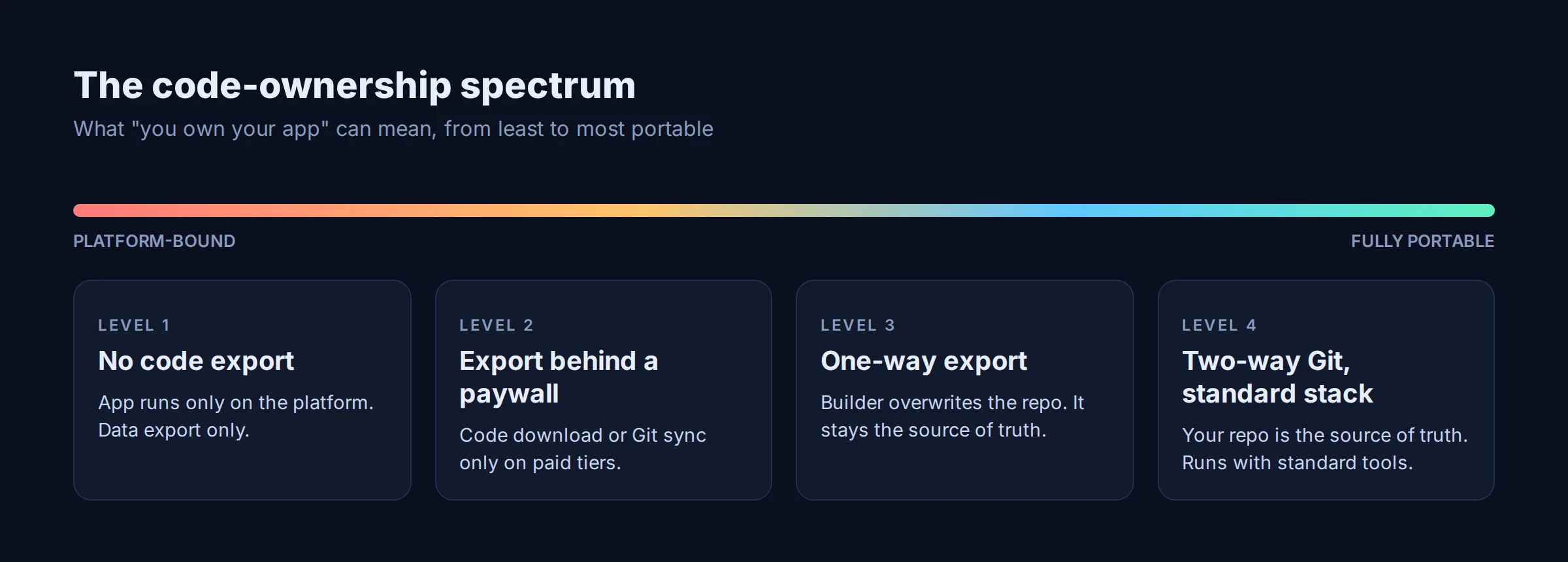
A few years ago "can I export my code?" was a real differentiator. In 2026 it mostly isn't. As of September 2026:
- Lovable offers two-way GitHub sync on all plans, and a direct code download on paid plans (Lovable docs).
- Bolt lets you download a project as a zip and run it with
npm install && npm run dev, and syncs to GitHub on every change (Bolt help). - Replit, v0 and Rork all connect to GitHub. v0 goes as far as calling the repository "the source of truth for your project's code" (v0 docs).
- FlutterFlow exports real Flutter code, but gates code download and GitHub integration behind paid tiers (FlutterFlow pricing).
The clear exception is Bubble, and its manual says so plainly: "Bubble apps can only be run on the Bubble platform; there's no way of exporting your application as code," and "Bubble retains ownership of the underlying code that powers your app." You can export your data as CSV. You can't take the app (Bubble manual).
So if nearly everyone exports, why does ownership still matter? Because "you can download a zip" and "you own a codebase you can run, hire for and fix" are very different claims.
Why the repo matters more than it used to
Vendors change course, and some disappear
Platforms don't have to fail for this to matter; they only have to change direction. Google App Maker is the cleanest example. In January 2020, Google announced that "due to low usage" it would turn App Maker down. New apps were blocked from April 15, 2020, and existing apps stopped working on January 19, 2021. Customers could keep their data in Cloud SQL, but the apps themselves were gone (Google Workspace Updates).
Compare Parse, Facebook's backend service, which shut down in January 2017. Parse was survivable for many teams because Facebook released an open-source Parse Server and a migration path (InfoQ), and the project still lives on at parse-community/parse-server. Same kind of event, very different outcome, and the difference was whether an open, runnable version of the thing existed.
The AI builder market is younger and more volatile than either of those. Builder.ai, an AI-powered app development company, entered insolvency proceedings in May 2025 (Tech.eu). Stacks shift too: Rork has moved new projects from Expo to native Swift and Kotlin (Rork docs). That's a reasonable product decision, and it's also a reminder that the builder's defaults can change under you. Code you already exported keeps running either way.
AI-generated code needs review, and review needs the code
The second reason is less dramatic and more important. AI-written code is fluent, and fluent isn't the same as correct.
- Veracode's 2025 GenAI Code Security Report tested more than 100 models on the same set of coding tasks. It found that "45% of code samples failed security tests and introduced OWASP Top 10 security vulnerabilities," and that newer models weren't more secure despite writing more functional code (Veracode, July 2025). Their Spring 2026 follow-up, covering over 150 models, says roughly 55% of generation tasks produce secure code, about where it was two years earlier (Veracode, March 2026).
- A Stanford user study found that participants with an AI assistant wrote less secure code than those without one, and were more likely to believe their code was secure (Perry et al., ACM CCS '23).
- In the 2025 Stack Overflow Developer Survey, 45.7% of respondents said they distrust the accuracy of AI tools, against 32.7% who trust it. The top frustration, cited by 66%, was "AI solutions that are almost right, but not quite" (Stack Overflow, 2025).
Put those together and the conclusion is simple: someone is going to review, test and patch AI-generated code. You can only do that with code you can read, diff, run a scanner over, and fix with ordinary tools. A platform that hides the code also hides the bugs from you, but not from your users.
Google's DORA research points the same way. The 2025 report describes AI as an amplifier: it still has a negative relationship with delivery stability, and teams with strong foundations like version control, testing and fast feedback are the ones who benefit (Google Cloud, September 2025). A real Git repository is one of those foundations.
The strongest case against us
It would be convenient to stop here. But the best arguments on the other side are good, and you should weigh them.
"My users don't read code." A founder validating an idea, or an ops team building an internal tool, may never open the repo. For them, a managed platform that handles hosting, scaling and security can be worth more than a codebase nobody will maintain. Lock-in is a price, and sometimes it's a fair one for speed.
"Owning messy code isn't ownership." GitClear's analysis of 211 million changed lines found copy/pasted code rising and refactoring falling as AI assistants spread: "4x more code cloning," with refactored lines dropping from 25% of changes in 2021 to under 10% in 2024 (GitClear). That's a correlation, not proof that AI caused it, but it's a warning worth taking seriously. A repo full of duplicated, half-understood code can cost more to own than a well-run platform.
"Speed is the point." Most prototypes never need to leave the tool they were built in. DORA 2025 links AI adoption with higher throughput and better product performance. Optimizing for a migration you'll probably never do can slow you down on the thing that matters now.
"Export is only partial anyway." Your frontend code may be portable while your auth, database and hosting are not.
We agree with a lot of that. It's why we don't think "can I export?" is the right question anymore.
A better test: would a developer accept this repo on day one?
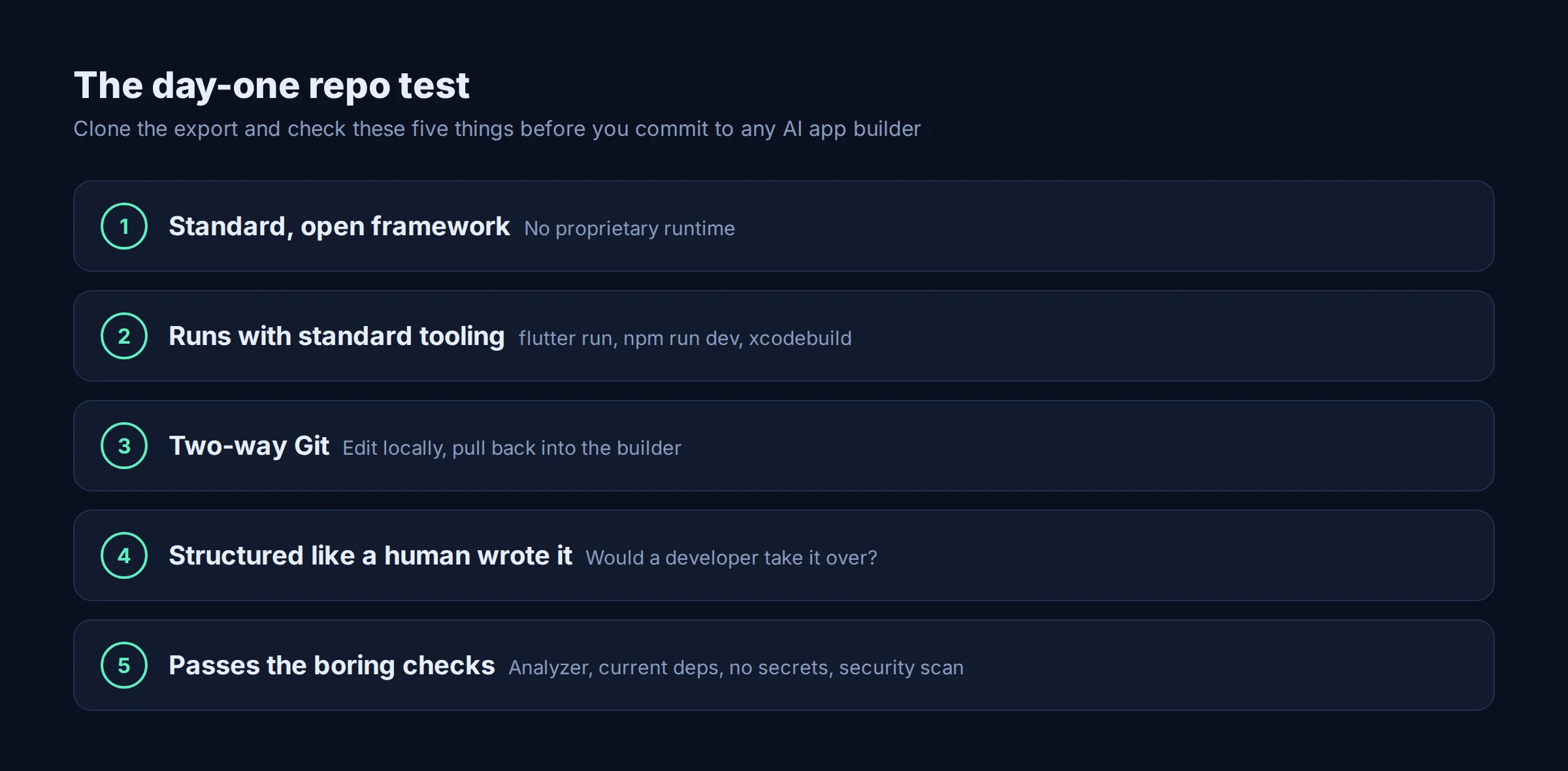
If export is table stakes, judge the export. Before committing to any AI app builder, including ours, clone the repo and check five things:
- Is it a standard, open framework? Not a proprietary runtime or a wrapper that only runs inside the builder. For mobile, that means something like Flutter, React Native, Swift or Kotlin, with a talent pool you can hire from. Flutter, for example, is BSD-licensed and reported "over 1.5 million monthly developers" in May 2026 (Flutter 3.44 release).
- Does it run with standard tooling?
flutter run,npm run dev,xcodebuild. If it needs the builder's cloud to start, you don't own it yet. - Is Git a two-way source of truth? Can you edit the code in your own editor and pull the changes back into the builder? One-way sync is a warning sign. FlutterFlow, for instance, pushes to a
flutterflowbranch and warns that direct changes "will be overwritten by the next push" (FlutterFlow docs). That's a sensible design for their model, but it means the builder, not your repo, is the source of truth. - Is it structured like a human would structure it? Features in folders, state management a Flutter or React developer recognizes, no 3,000-line files. Give it to a developer for an hour and ask whether they'd take it over.
- Does it pass the boring checks? Static analysis runs clean, dependencies are current, secrets aren't committed, and a security scanner has something sensible to say. Given the Veracode numbers, this one isn't optional.
A builder that passes all five gives you the demo and the exit. One that fails them gives you only the demo.
How we apply this to FlutterGo
We built FlutterGo around this test, so it's fair to hold us to it. FlutterGo generates standard Flutter and Dart code. In a reading list app we built and reviewed, that meant feature folders, go_router for navigation and a plain ChangeNotifier for state, all running with standard Flutter tooling. You can push the project to a private GitHub repository, edit it in any editor, and pull changes back, or download the whole project as a zip (export docs). Code access isn't gated by plan: our billing docs say that if your subscription ends, "you can still get your code from GitHub, only the paid FlutterGo features stop working" (plans and billing).
That doesn't make our output perfect. Generated code still deserves the same review you'd give a new teammate's first pull request, and the counterarguments above apply to us as much as anyone. The point is that you can do that review, with your tools, on your repo.
We've written about how FlutterGo detects and fixes errors in generated Flutter code, which covers the analyze-and-repair step in the build pipeline.
The question to ask next time
The next time an AI builder wows you in a demo, ask for the repo. Clone it, run it with standard tools, and hand it to the most skeptical developer you know. What they say after an hour is worth more than anything you saw in the first minute.
If you want to try that with us, start a project in FlutterGo, connect GitHub, and run flutter analyze on what comes out.
New to FlutterGo? Start with what FlutterGo is and what it generates.
Product details for the builders mentioned were checked against their official documentation on September 30, 2026, and may change.